AI can produce code quickly. A software team only benefits when that code becomes a useful, tested change in the hands of users. The opportunity is to improve the whole software development lifecycle (SDLC): the path from an idea to a verified release.
At Ignituz Global, our AI-first approach is the Ignituz Global AI Development Lifecycle (AI DLC). AI assists the work, automation assembles and checks evidence, and people retain responsibility for the decisions that matter.
The AI DLC process, at a glance
Seven agent roles work across implementation, independent review, candidate validation, release preparation, live checks, and fix/status reconciliation. Experts define the work and retain the decisions shown as human checkpoints.
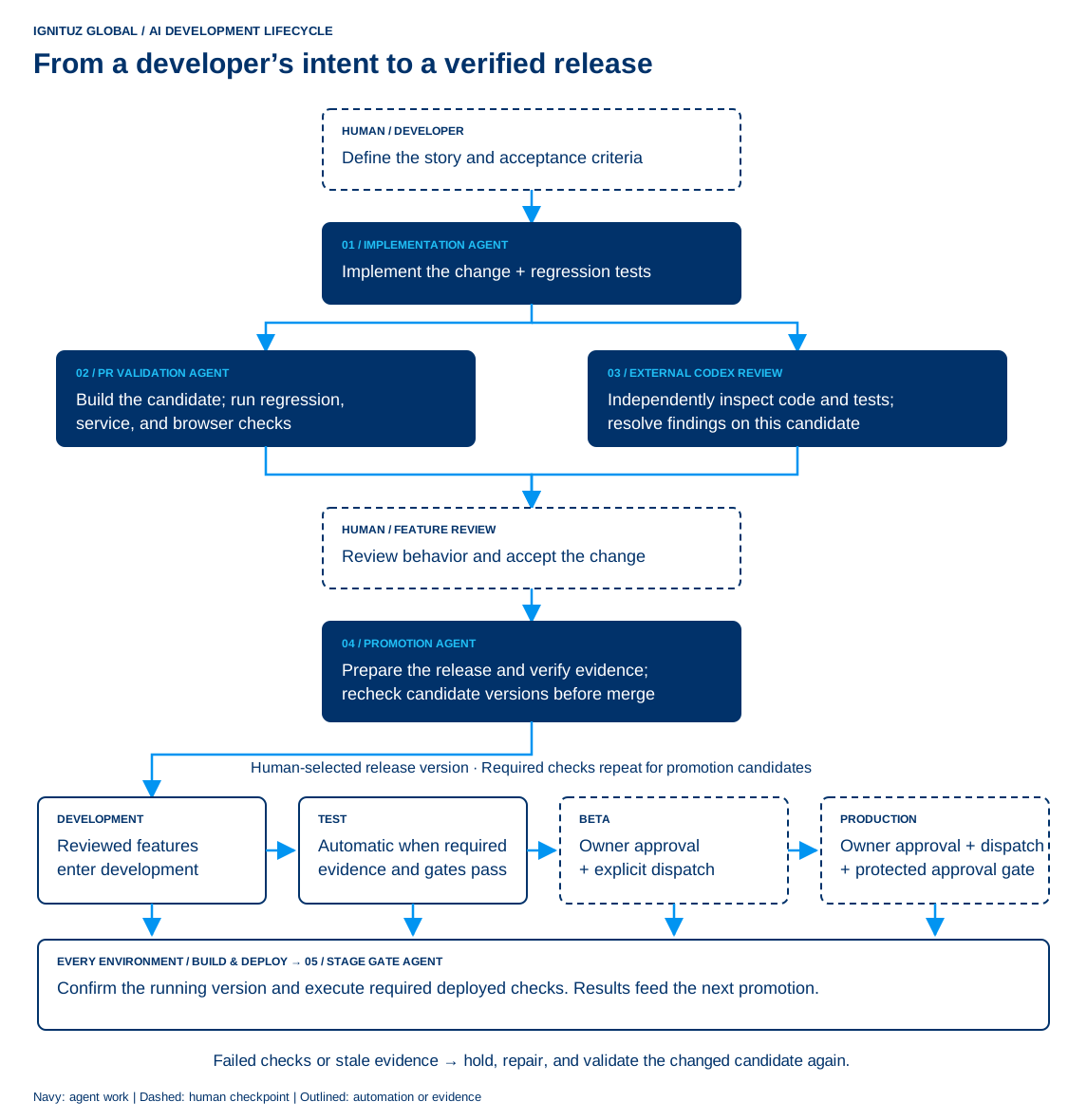
Developer intent flows through implementation, parallel validation and external Codex review, human review, promotion, deployment, and Stage Gate checks. Beta and production retain explicit human approval gates.
Open full-size diagram ↗Download SVG ↓Promotion through four environments
- DevelopmentHuman-reviewed features
Deploy + stage checks - TestAutomatic promotion when gates pass
Human-selected release version - BetaRelease-owner approval
Explicit merge dispatch - ProductionRelease-owner approval + dispatch
Protected production approval gate
Candidate validation and independent review apply to promotion readiness too. The Stage Gate checks the deployed version in each environment. Approval alone does not initiate a beta or production merge; an operator starts the approved action.
The seven agent roles
Implementation Agent
Purpose: turn a bounded specification into a proposed software change under expert direction.
Work: use the agreed context, implement on a branch, add relevant tests, prepare the pull request, and address findings. This is the developer’s AI coding assistant role; it does not approve its own work.
Output: a reviewable candidate with an explanation of the change and its checks.
PR Validation Agent
Purpose: establish whether the candidate satisfies the required validation policy.
Work: classify impact; for operational changes, build and deploy a candidate locally, then run the required regression, service-verification, and browser tests. Non-operational changes can receive an explicit policy-based skip.
Output: a pass, fail, or intentional-skip result tied to the candidate version.
External Codex Review Agent
Purpose: challenge AI-authored implementation independently of its author.
Work: inspect the change for defects, raise actionable findings, and re-evaluate fixes. Automatic external Codex PR review is integral to the workflow. Fixes trigger fresh review, and a clean verdict must identify the current candidate.
Output: findings to resolve, or a clean review record for the reviewed version. Human feature review remains a separate checkpoint.
Promotion Agent
Purpose: assemble releases and determine whether a candidate may progress.
Work: batch reviewed changes, prepare release notes, gather validation and review evidence, check source-stage health and eligibility, and recheck the live source and target versions before merging where policy permits. Development-to-test can advance automatically; beta and production require release-owner approval and explicit dispatch.
Output: a prepared release candidate, a permitted promotion, or an explicit list of blockers. People choose the release version; the agent does not silently override failed gates.
Stage Gate Agent
Purpose: establish whether the intended deployed version passes the required checks.
Work: wait for deployment to settle, verify the running version, and run the required regression, live-service, and browser checks. A newer deployment supersedes evidence for an older version.
Output: a version-specific deployed-stage verdict used in the next release decision. The production deployment workflow initiates the production gate after the approved rollout.
Cleanup Agent
Purpose: unblock eligible, already-approved feature PRs whose validation is failing.
Work: verify that approval covers the current candidate, bring the branch up to date where safe, diagnose the failure, and run type, lint, build, and affected-test checks. A scoped repair is accepted only after verification. The agent must not weaken tests to force a pass, and reports conflicts it cannot safely resolve.
Output: a verified repair or a blocker. Changed candidates receive fresh Codex code and security review requests, renewed human review requests, and a Jira audit comment. Unapproved, fork-sourced, draft, and promotion PRs are outside this repair lane.
Jira State Agent
Purpose: reconcile story status with current PR, branch, approval, and deployment evidence.
Work: inspect open and recently merged PRs, derive the appropriate stage, and repair missed updates idempotently. A post-approval local fix returns to review; later-stage work is not indiscriminately moved backwards. Deployment recovery requires evidence of an actual rollout, not merely a successful image build.
Output: an audited story update or an explicit hold when evidence or transitions are unavailable. It preserves human approval gates and does not invent deployment or Stage Gate success. This agent uses deterministic reconciliation logic, not an LLM making status judgments.
The supporting system: build and deployment workflows execute releases, the repository stores changes and review evidence, and work tracking records delivery status. These support the agent roles; human reviewers and release owners remain accountable for their decisions.
The developer is the process owner
The Ignituz Global AI Development Lifecycle (AI DLC) depends on developers who understand the product and can challenge the tools. Agents execute work within boundaries; developers establish those boundaries, inspect the evidence, and take responsibility for the result.
- Frame the problem: clarify the story, acceptance criteria, data handling, permissions, and failure behavior. Choose a full specification for complex or sensitive work.
- Guide implementation: provide relevant context, make architecture decisions, and work in changes small enough to review. Inspect the actual diff and running behavior.
- Build the safety net: add meaningful regression tests alongside each new behavior and defect fix. Keep service and browser coverage aligned with the user journey.
- Resolve feedback: examine every review finding, implement justified fixes, and request another review. A fresh commit needs fresh evidence.
- Finish the delivery: update translations, permissions checks, security work, documentation, and the story record. Verify the deployed result and follow through on failures.
A developer’s “done” means a change has passed the required review and validation and reached its intended environment with evidence. Generating code, opening a PR, or seeing one passing check is only part of that work.
Skills make the process repeatable
A workflow skill packages the delivery instructions, checklists, and tool usage into a repeatable routine. It helps a developer or coding agent carry a story through specification, implementation, finishing, and promotion without relying on memory.
The skill coordinates the work; repository checks, permissions, and release gates enforce the boundaries. Instructions to run a check are useful, but the required check must also be part of the merge or release decision.
| Capability | What it checks or coordinates |
|---|---|
| Specification and planning | Requirements, design, task breakdown, acceptance criteria, and the choice between a short plan and a fuller specification. |
| Delivery workflow | A linked story, isolated work area, feature branch, local checks, PR preparation, release evidence, and post-deployment follow-through. |
| Code and security review | Developer inspection, external Codex review requests, resolution of findings, and another review of the changed candidate. |
| Internationalization | User-facing text and translation coverage across supported locales. Review missing keys, fallback behavior, formatting, and layouts affected by translated content. |
| Permissions and data protection | Authorization behavior, denied-access regression cases, encryption requirements, audit trails, and avoiding secrets in code or logs. |
| Dependency security | Relevant vulnerability findings and verified remediation, including whether a dependency change still builds and runs correctly. |
| Testing and documentation | Regression, service-verification, and browser coverage, plus updates to technical, user, and operational documentation. |
A generic command vocabulary
The examples below use /ai-dlc as an illustrative, project-neutral command prefix. The installed command name depends on the team’s tooling. Each command invokes a defined workflow phase; it does not bypass approval or validation.
| Example command | Developer intent and expected outcome |
|---|---|
/ai-dlc help/ai-dlc version | Inspect available commands and the installed workflow version. |
/ai-dlc spec STORY-123 all | Develop requirements, design, and tasks for complex work. Planning alone does not begin implementation. |
/ai-dlc plan STORY-123 | Prepare a concise plan for a narrow, well-understood change. |
/ai-dlc start STORY-123 | Claim the work, prepare an isolated branch and work area, and establish the implementation plan. |
/ai-dlc work STORY-123 | Iterate on implementation and tests, run local checks, and maintain the draft PR. |
/ai-dlc finish STORY-123 | Harden the candidate: review, translations, security, regression coverage, documentation, and story evidence. |
/ai-dlc merge STORY-123 | Proceed only when required review and validation are satisfied, then observe deployment and stage checks. |
/ai-dlc jira assigned me/ai-dlc jira sprint current/ai-dlc jira stories | Inspect assigned work, sprint scope, and stories without treating a lookup as authorization to change them. |
Testing is the system of checks and balances
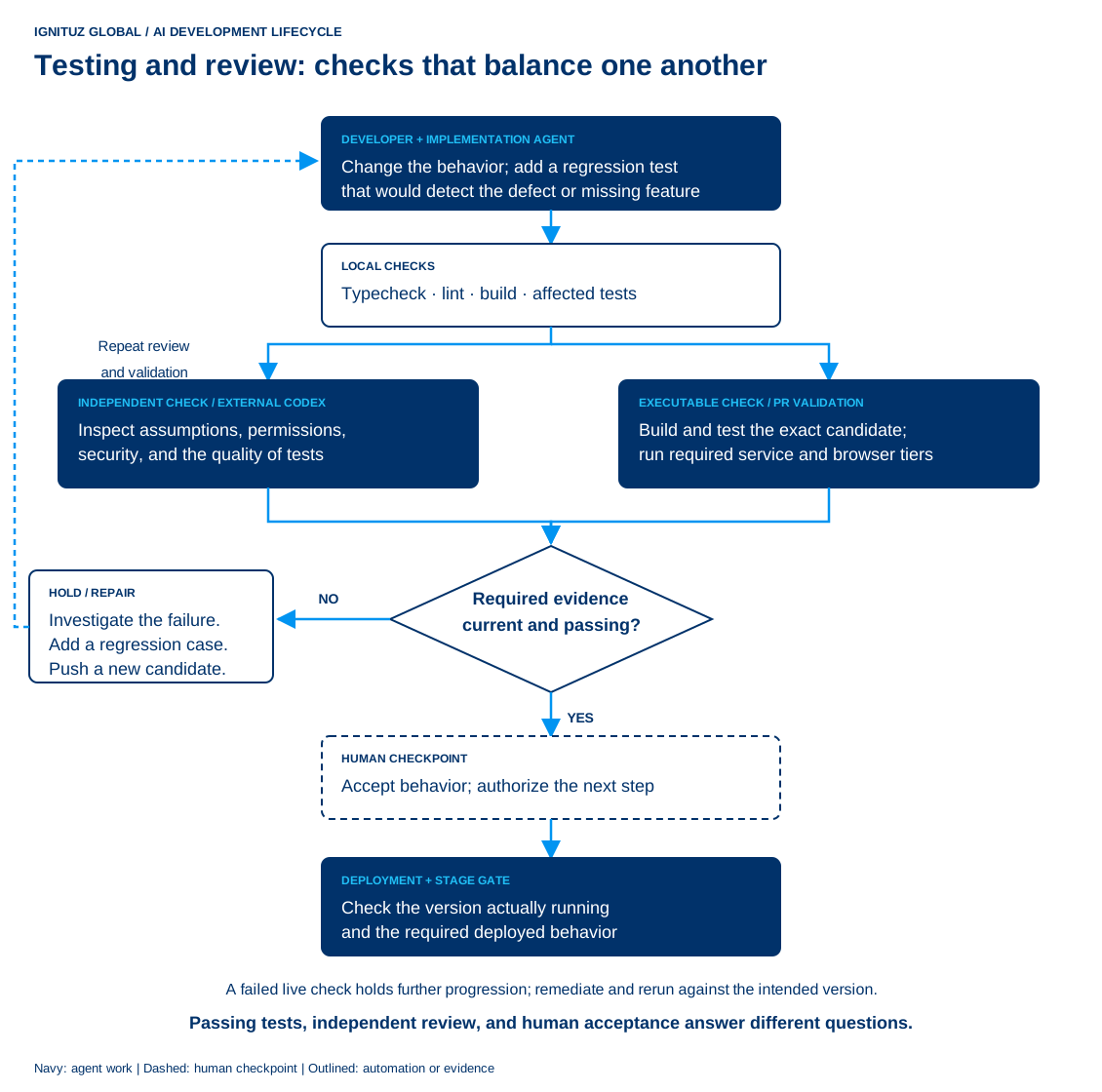
Regression tests grow with each change. Local checks feed independent review and candidate validation; failed or stale evidence returns to repair. Human acceptance and deployed checks complete the loop.
Open full-size diagram ↗Download SVG ↓AI can repeat an incorrect assumption in both code and generated tests. Independent review and several kinds of validation make that easier to detect. Each mechanism answers a different question, and none substitutes for all the others.
| Mechanism | Question it answers | Check or balance |
|---|---|---|
| Type, lint, and build checks | Does the change satisfy basic static and build requirements? | Fast feedback before wider testing; a successful build does not prove correct behavior. |
| Targeted regression tests | Does the feature or fix behave as intended, including failure cases? | Acceptance criteria and reproduced defects become repeatable checks against recurrence. |
| Service verification | Do services and integrations behave correctly in their intended environment? | Checks real service boundaries, permissions, and integration behavior that isolated tests can miss. |
| Browser journeys | Can a user complete the intended workflow? | Exercises the interface, navigation, and connected behavior from a user’s perspective. |
| External Codex PR review | Are there defects or overlooked risks in the implementation and its tests? | Independent challenge to the author’s assumptions; complements executable checks. |
| Candidate validation | Does this exact candidate build, deploy, and pass the required tiers? | Binds the result to the version being considered for integration. |
| Deployed Stage Gate | Is the intended version running, and does it pass the required checks? | Detects deployment and environment issues after candidate validation. |
| Human acceptance | Does this result meet the need, and should it progress? | Retains product judgment and release accountability. |
Build the regression suite as the product grows
Every meaningful behavior change should bring relevant coverage with it. For a defect, first capture the failing scenario where practical, then implement the fix and confirm that the new check distinguishes the broken behavior from the corrected result. Include boundary conditions and denied actions, not only the happy path.
For example, a fix to restricted document access should test both an authorized user’s successful access and an unauthorized user’s rejection. Add service coverage for the authorization boundary and a browser case when the user journey changes. A test that merely checks whether a button exists would not establish the permission rule.
When a review finding reveals a missed case, turn it into lasting regression coverage. Run affected checks while iterating and the required wider checks before promotion. If intended behavior changes, update the specification and test with a clear reason. Never weaken, skip, or delete a test simply to obtain a passing result.
External Codex review is integral to delivery
Automatic external Codex PR review provides an independent examination of AI-authored changes. It is a required part of the review loop, alongside the developer’s own inspection, executable validation, and human approval. A security review can be requested as part of the workflow’s security checks.
The loop is explicit: request review, assess findings, fix the justified issues, add regression coverage, push the new candidate, and request review again. The clean review record must cover the current version; a verdict for an earlier commit does not establish readiness after a new fix.
Cleanup-generated changes re-enter this same loop. An earlier human approval does not mean a later automated repair can silently inherit all of its review evidence.
Reconcile the fix, the release, and the story
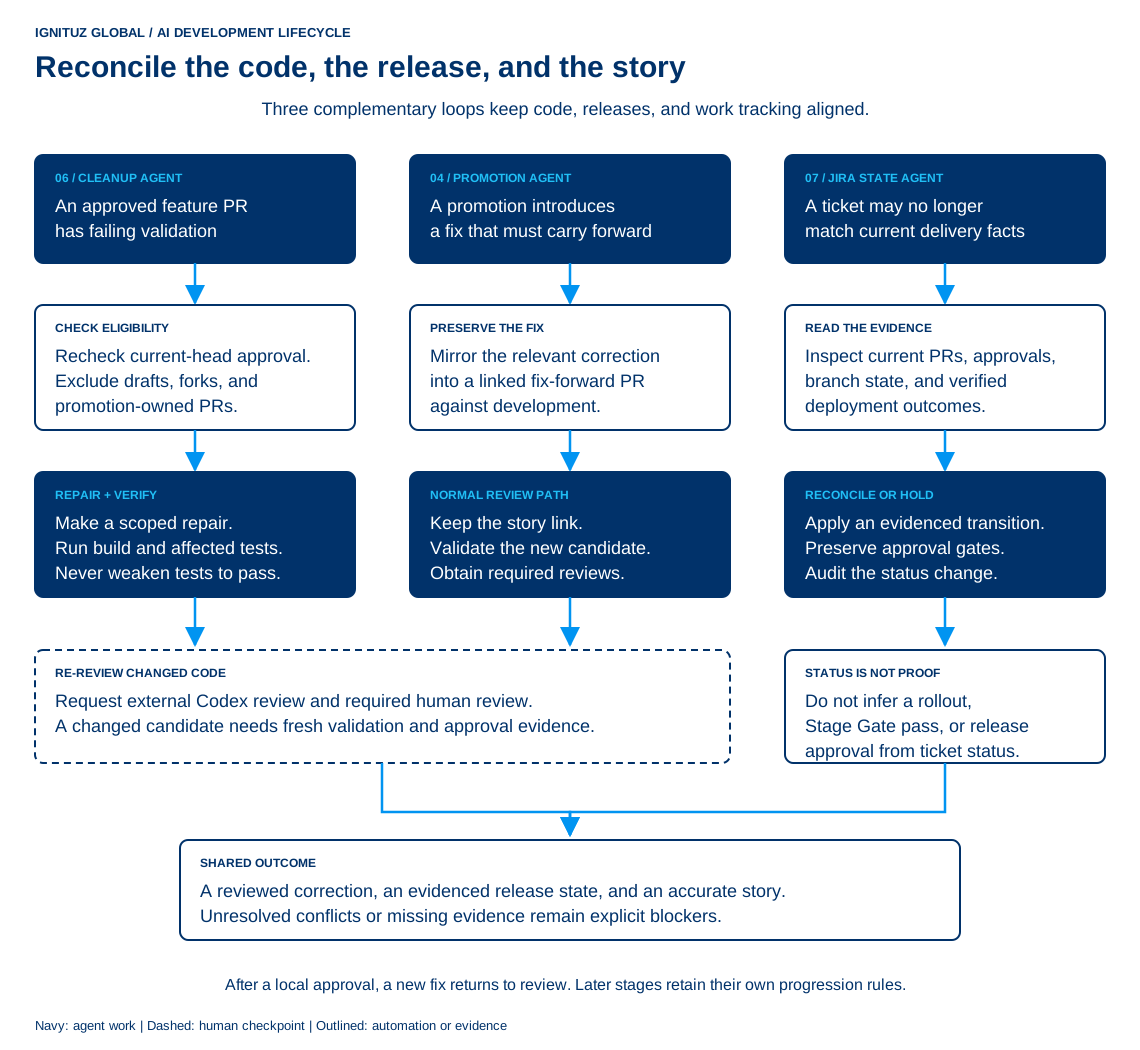
Cleanup repairs eligible approved PRs; Promotion carries fixes into the normal development review path; Jira State reconciles tracking against current evidence. Changed code returns to review and validation.
Open full-size diagram ↗Download SVG ↓Delivery can drift even when individual tools work: a fix lands after approval, a higher-environment correction is missing from the development branch, or a ticket misses a status update. Reconciliation closes those gaps without treating them as permission to bypass checks.
- Repair an eligible stalled candidate: the Cleanup Agent checks current eligibility, diagnoses failing validation, and verifies a scoped repair. It re-requests external Codex and human reviews after pushing a change.
- Carry release fixes forward: the Promotion Agent brings relevant promotion fixes back through the normal development review path so future releases preserve them. The fix-forward work remains linked to a story and validation evidence.
- Reconcile the story: the Jira State Agent compares the ticket with current PR, branch, approval, and deployment facts. It repairs missed transitions only when the required evidence exists.
These agents have different jobs. Cleanup repairs eligible feature PRs; Promotion owns promotion candidates and fix-forward reconciliation; Jira State reconciles tracking. A ticket’s status is not a substitute for a tested build, a verified rollout, or a release approval.
The acceleration comes from connecting the steps
In a fragmented workflow, teams wait for someone to reproduce a build, collect test results, work out what changed, or confirm which version is running. Each handoff adds delay and creates another chance to lose context.
An AI-led development lifecycle connects those steps. The specification informs implementation. The change informs validation. Validation evidence accompanies review. Deployment is followed by checks against the running application. Release preparation reuses the same evidence.
The unit of progress is a verified change, not a volume of generated code.
What our AI DLC puts into practice
1. Validate the candidate before it moves forward
Ignituz Global’s PR Validation Agent classifies the impact of a change. Operational changes are built, deployed in a validation environment, and checked with the required regression, service-verification, and browser tests. Non-operational changes can receive an intentional skip.
This shortens the feedback loop: a failed candidate returns to the author with evidence before it reaches the next environment. A skipped check must still be an explicit policy outcome.
2. Combine independent review with human judgment
AI-authored changes receive independent code review, and feature changes require human review before entering the development branch. Validation and independent review evidence are associated with the candidate commit. When the candidate changes, the earlier machine evidence no longer establishes readiness for the new version.
This is how a team can delegate implementation while continuing to challenge assumptions, inspect behavior, and own the result.
3. Test the application that is actually running
Ignituz Global’s Stage Gate waits for deployment and checks the running version against the intended change. It can run regression, live service, and browser checks. A superseded deployment must not be reported as evidence for a different build.
The benefit is a more direct answer to the release question: did the intended version deploy, and does it pass the required checks in that environment?
4. Prepare promotion from evidence
The Promotion Agent assembles release information and checks whether the candidate is eligible to move forward. Development-to-test promotion can proceed automatically when its gates are green. Beta and production transitions retain release-owner approval and an explicit merge dispatch; production also has a protected approval gate.
Humans still choose the release version. Missing or stale evidence blocks progress. These boundaries are part of the delivery design.
Why this can make delivery faster
- Less manual preparation: repeatable validation and release evidence can be assembled without someone collecting every result by hand.
- Earlier feedback: candidate testing exposes defects before they spread into later environments.
- Less uncertainty: version checks connect the intended release to what is actually deployed.
- Focused human attention: reviewers can spend more time on intent, design, and risk when routine checks are already available.
These are mechanisms for acceleration, not a measured speed-up claim. Results depend on the project, team, and delivery context.
Measure the outcome, not the activity
Establish a baseline before changing the workflow. Track lead time from accepted work to release, time waiting for review, first-pass validation success, escaped defects, and recovery time. Compare similar types of changes and account for the cost of running and maintaining the automation.
If code generation rises while review queues or defects grow, the workflow has not improved. A useful AI DLC reduces time to a reliable outcome.
Start with one complete path
Choose a bounded product area. Define acceptance criteria and review ownership. Add candidate validation, then a deployed-version check. Make the release evidence repeatable. Expand once the team can explain both how a change passes and why it is blocked.
This is where our three areas of expertise meet: AI Governance defines the boundaries, AI Development implements the workflow, and AI Training gives people the skills to operate and question it.